

5 Benefits of Pranayama for Stress, Sleep and Focus

Updated: 2 days ago

The 5 benefits of pranayama most people notice are lower stress, better sleep, sharper focus, steadier emotions and easier breathing.
Pranayama works by changing the pace and pattern of your breath, which influences your nervous system.
If your mind is still racing at 11 pm, your focus scatters by mid-afternoon, or your body stays "on" all day, this is worth understanding.
At a high level, pranayama looks like regulating the breath through patterns of inhalation, exhalation and, later, retention, but it has a much subtler understanding in yogic science. Each benefit below comes with what research does and does not show, and a technique to try.
I came to pranayama because of my own asthma, and this is how I teach it at Yogavijnana.
What exactly is pranayama?
Prana is the vital energy that animates the body; ayama is its expansion. Patanjali defines pranayama (Yoga Sutra 2.49) as the regulation of the flow of inhalation and exhalation, taken up once posture is steady [1].
In my teaching, ayama means expanding awareness, not stretching or forcing the breath, as I wrote in Essence of Ayama in Pranayama.
The Hatha Yoga Pradipika (2.2) links breath and mind: when the breath is disturbed, so is the mind, and when it steadies, so does the mind [2].
The Sutras name the result: a mind fit for concentration (2.53) [1]. The five benefits below are best read as by-products of that older purpose.
The 5 Benefits of Pranayama at a Glance
Benefit | How it helps | Technique to try | Time needed |
Stress relief | Slows the breath, lengthens the exhale | Vibhagiya, Sama Vritti | 5 min |
Better sleep | Helps the body wind down | Bhramari, extended exhale | 5 to 10 min |
Sharper focus | Gives attention one steady task | Nadi Shodhana | 5 to 10 min |
Emotional balance | Builds noticing before reacting | Ujjayi, Sama Vritti | 5 to 10 min |
Better breathing | Retrains breathing habits | Vibhagiya, Ujjayi | 5 to 10 min |
Before you try any of these
|
Benefit 1: Pranayama for Stress, Calming the Nervous System
How does pranayama reduce stress?
Slow, even breathing with an unhurried exhale gives the body a steady signal that nothing is wrong, and the nervous system tends to follow.
How it works | Sama Vritti, "equal movement", matches inhale to exhale: the gentlest pattern, with no retention. |
Try it |
|
Best time | When tension builds, such as before a meeting or after the commute. |
Evidence | A review of 15 studies, chosen from 2,461 abstracts, linked slow breathing (under ten breaths a minute) to higher heart rate variability, lower anxiety symptoms and more relaxation. None of its studies reported a direct stress measure [4]. |
Take care | If you feel breathless, shorten the count. |
Benefit 2: Pranayama for Sleep, Winding Down Naturally
Which pranayama is best before bed?
Bhramari, the humming breath, and an exhale twice as long as the inhale are the two patterns I teach for evenings. Think of pranayama for sleep as a wind-down habit.
How it works | The hum slows the exhale and gives a restless mind one sound to follow. A 1:2 ratio, in for three and out for six, lengthens the exhale without strain. In ten healthy people, nasal nitric oxide rose about fifteen-fold during humming [5]: a finding about the nose, not proof about sleep. |
Try Bhramari |
|
10-minute routine | Two minutes lying down, watching the natural breath; three of Vibhagiya; three in for three, out for six; two of Bhramari, then silence. |
Best time | The hour before bed. |
Evidence | A review of six Bhramari studies found very low methodological quality and no randomised trials [6]. In 410 cancer survivors, a four-week yoga program that included pranayama improved sleep quality compared with usual care, though pranayama was only one part [7]. If poor sleep lasts for weeks, see a doctor. |
Take care | Never strain to lengthen the exhale. |

Benefit 3: Pranayama for Focus, Training Your Attention
Can pranayama improve concentration?
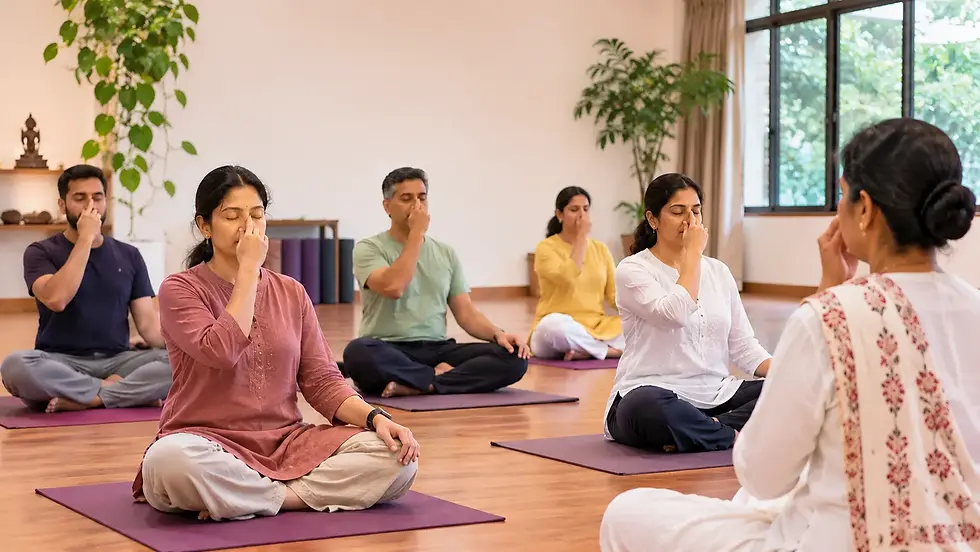
That is what the classical texts say it is for: Yoga Sutra 2.53 says the mind becomes fit for concentration [1]. Nadi Shodhana, alternate nostril breathing, is how I begin.
How it works | Alternating nostrils gives attention a small, steady task. The Hatha Yoga Pradipika treats it as preparation for other pranayama [2]. |
Try it |
|
Best time | Before work, study or meditation. |
Evidence | A systematic review of 44 randomised trials of alternate nostril breathing reported better cognitive functioning with regular practice. Most participants were healthy, the technique is not yet standardised, and the best frequency and duration are not settled [8]. I teach it for the steadiness the Sutras describe, not for a test score. |
Take care | Skip it if your nose is blocked. |
Benefit 4: Emotional Balance and Resilience
The breath changes with every emotion, so following it gives you a few seconds of choice before you react.
In the slow-breathing review, anger, depression and confusion scores fell [4], though the studies covered slow breathing in general.
Ujjayi, with its soft throat sound, makes the breath easy to follow.
Try Ujjayi |
|
Best time | Daily when calm, so it is available when you are not. |
Take care | If the throat tightens or the sound turns harsh, soften it. |
Benefit 5: Better Breathing Habits and Lung Awareness
Many of us breathe high in the chest with working shoulders. Vibhagiya, the three-part breath, retrains the movement: belly, then ribs, then upper chest.
Try Vibhagiya |
|
Best time | Morning, or after a long stretch at the desk. |
Evidence | This benefit rests on technique, not on a trial I can cite. |
Take care | Stop if you feel dizzy; keep the belly soft, not pushed out. |
Join a Pranayama Workshop at Yogavijnana: Yoga Classes in Bangalore
You can begin everything above at home. A workshop adds what a page cannot: a teacher who watches your posture, ratio and effort and corrects you before strain builds.
I lead it myself. I began pranayama to manage my own asthma; that is my personal experience, not a promise, and never a substitute for medical advice.
It is open to all levels. You learn techniques step by step with the science behind each one, build breath awareness and practice safely on your own.
How to choose a pranayama workshop
|
Format | Live, 8 sessions |
Where | Yogavijnana, Chandra Layout, Vijayanagar, Bangalore |
Dates, time and fee | See the Pranayama workshop page for the next batch dates, timings and latest fee. |
Register for the pranayama workshop Workshop details → yogavijnana.in/pranayama-workshop |
Frequently Asked Questions
What are the main benefits of pranayama?
Lower stress, better sleep, sharper focus, steadier emotions and easier breathing. Research is more limited for sleep than for relaxation and mood.
How long does pranayama take to work?
Many people feel calmer within one session. Changes in sleep, focus and breathing take weeks of regular practice, and no honest teacher can promise a number of days.
Which pranayama is best for stress?
Start with Sama Vritti or Vibhagiya. Both are gentle and need no retention.
What happens if I do pranayama every day?
Short, gentle daily practice builds the habit and the skill. Forceful techniques or long retention every day can strain the body.
How much pranayama per day?
For the gentle techniques here, five to ten minutes once or twice a day. Add retention or forceful techniques only with a teacher.
Who should not do pranayama?
Check with your doctor or a Yoga Chikitsa Acharya (yoga therapist) first if you are pregnant or have asthma, a heart or blood-pressure condition or recent surgery. Beginners should avoid forceful techniques and long retention.
Should we do pranayama first or asana?
Asana first, then pranayama. Yoga Sutra 2.49 takes it up once posture is steady [1], and the Hatha Yoga Pradipika follows the same order [2].
Can pranayama help with sleep?
It may help you wind down; Bhramari and a long exhale are common choices. Evidence is limited, so treat it as a habit, not a treatment.
Is pranayama good for concentration and focus?
Yoga Sutra 2.53 says it prepares the mind for concentration, and a review of alternate nostril breathing trials reported better cognitive functioning [8].
Is pranayama safe for beginners?
Gentle techniques without retention suit most healthy beginners. The risk comes from forcing the breath, so learn under a qualified instructor [3].
Do I need a pranayama workshop, or can I learn at home?
You can begin the gentle techniques at home. A workshop adds live correction and a safe order for adding techniques.
Conclusion
The 5 benefits of pranayama are real enough to try and honest enough to question.
Start with five quiet minutes of Sama Vritti tonight, notice what changes, and when you want to go further, learn with a teacher at our pranayama workshop.
Questions about pranayama?See our pranayama workshop → yogavijnana.in/pranayama-workshop Contact us → yogavijnana.in/contact-us |


Comments